 Home
Forum
Starcraft Tournaments
Home
Forum
Starcraft Tournaments
|
Welcome to the largest collection of Starcraft battle reports on the internet.
Join the ranks of famous reporters by writing about your Starcraft games. We also gladly
accept reports and tournaments of other types of games.
Battle ReportsView Reports Report Search Hall of Fame Top Reporters File Upload Center SUBMIT REPORTS Replays View Replays Top Replays Most Recent Replay Search SUBMIT REPLAYS Other Wiki Downloads Interviews FAQ Help Guides 
|
|
|||||||||||||||||||||||||||
|
RC Tycoon Fundamentals
When I look back at my childhood, I am instantly reminded of a special
selection of video games. My experiences began with Super Mario World when I was
five or so. This single game sparked my interest in the industry, and
following SMW was a myriad of other "brain rotters," as my grandma used
to call them. There was Starcraft, Goldeneye 007, Mario Kart 64, and
Crash Bandicoot to name a few. Among these titles was a strategy
game where you manage theme parks and build roller coasters - the 1999
simulator, Roller Coaster Tycoon.
Considering its vast popularity, I'm assuming that the majority of you
have played it at some point, but for those stragglers out there, I'll
go through some of the rudimentary details.
In Roller Coaster Tycoon, you play the role of an amusement park manager.
The game has 21 unique scenarios in which you inherit ten grand, plus
whatever the bank is willing to loan you in order to construct and
maintain a theme park. As the park manager, you are in charge of well,
just about everything. You construct the attractions, design the layout,
hire employees, and dabble with economics. There are a variety of objectives
that the scenarios may demand. Typically, you must attain a specified
quota of guests with a park rating of at least 600 out of a possible
999, within a certain period of time. The park rating is based on your
guests' general happiness. If you fail to obtain either a
high enough park rating, the specified amount of guests, or both, the
government swoops in and confiscates everything you worked so hard on
(just like real life).
The rides in RCT have three dominant "ratings" which determine what guests
will enter the ride. All systems begin at 0.00 and can be increased
without a ceiling or cap. The higher the "excitement rating," the greater
the chance that a guest will enjoy the ride, and perhaps, ride it repeatedly.
If the excitement rating is too low, a guest may not bother with the
attraction. The "intensity rating" is quite similiar to the excitement
rating. If the intensity rating is too low, then a guest may skip over
it. However, if the intensity rating is too high, a guest may quiver in
fear, piss his pants a bit, and cry for his mummy. Lastly, there is
the "nausea rating," which indicates how likely it is for the guest to
blow chunks on the ride.
There are four different types of employees a park manager can hire. The
first is the Handyman. This guy dresses in spiffy overalls and carries
around a top-of-the-line mop at all times. His job is to keep things ship-shape
(this includes taking out the trash, watering the flower beds, mowing
the lawn, and sweeping up the puke).
Next, there are the Mechanics. These guys went to college, and can therefore
inspect and repair the most technologically advanced roller coasters on
the planet. They are arguably the most important individuals in the park,
and sport revealing jumpsuits.
What's an excellent park without security? This is where the Security
Guards come in. They prevent vandalism and maintain order in the park.
This keeps the park rating high, and lowers the rate of hissy fits, cat
fights, and mosh pits.
Finally, there are the Entertainers. They walk around in ridiculous
animal costumes doing all sorts of cartwheels and street moves. The
guests tend to get a real kick out of this, and their happiness (your park rating) increases
a bit as they pass by.
As a quick last note, amusement parks generally shut down in the winter.
The game is segmented in years beginning in March, and ending by November.
That should encompass the basics, so let's get this show on the road.
| ||||||||||||||||||||||||||||
|
"Deep in the forest, build a thriving theme park in a large cleared area." | ||||||||||||||||||||||||||||
|
March, Year 1
After I finished evaluating my congenial surroundings, I decided to take a look at
my construction options. These turned out to be close to abysmal, as far
as diversity was concerned. There was the classic Merry-go-Round, a Spiral
Slide, a Ferris Wheel, a "Scrambled Eggs" (similar to a tilt-a-whirl, but without the tilt),
and a Monorail (which served no purpose as of yet). To be honest, this
bored the hell out of me, so I skipped over to the roller coaster section.
Currently, there were two different types of coasters available - the
Steel Mini model and the standard Wooden model. While neither of them
allowed for any inversions, they provided double, perhaps even triple the
excitement rating of the other rides. From an economic standpoint, roller
coasters require the greatest input, yet yield the greatest output as well.
Aside from that, they are the centerpiece of any amusement park, and it's
always a blast to hear your guests screaming their lungs out on the corkscrews
and drops, as if they had just seen Johnny Vegas in his hiking ensemble.
So, instead of opting for a Merry-go-Round or Slide as the first investment,
I decided to try my luck in crafting a Steel Mini roller coaster. It was
one of the cheapest models out there, and it seemed like the perfect opportunity
to re-familiarize myself with the antics of the '99 engine. I surveyed
the park's shape once more, and I decided to begin construction near the
park's entrance. Although location is usually a top priority for roller
coaster development, a vacant, flat plot of land such as the one Forest Frontiers boasts
is one of the few exceptions - where location is only moderately important.
The only factor that
came into play was the distance between the coaster's entrance and the
actual park entrance. For maximum profit in the shortest amount of time,
the coaster should logically be constructed close to the park's gates.
With this bit of knowledge, I got out the jackhammer and set up shop
just to the right of the main path.
After welding the final piece to the station platform and completing the circuit,
a sense of accomplishment warmed my humble soul. Nostalgia overwhelmed my
being, and I got up on a bandstand to participate in a masterfully
choreographed Norwegian jig.
As I pulled my pants back up, I came to the acute realization that I was
not out of the thicket just yet. I still had to make sure that the roller
coaster could complete the circuit, and that the statistics were in
reasonable measure. As I mentioned earlier, the ratings are a crucial aspect
of roller coaster construction. An "intensity rating" above 12.00 will deter just
about every guest from the ride, and a "nausea rating" above 10.00 will have
guests tossing their cookies faster than a bulimic after a triple fudge
sundae.
From what I could see, the coaster seemed to be in good shape. I was
beginning to recall the physical parameters within the engine, and my
confidence in the new coaster did not diminish. I hit the "test" button,
and watched the two trains exit the station. They climbed up the lift hill
with many a clickidee-clack, and after a suspenseful handful of seconds,
the trains plummeted down to Earth, winding atop the twisted metal. They
raced around the wacky circuit through the up's and down's. They swooped
over the waves and ripples. It was a phenomenal sight, and pride bubbled
up inside me.
After a minute or so, the trains returned to the station, seemingly eager to give
it another go. The test results arrived almost instantaneously, and did
not disappoint. A medium excitement rating of 4.40 and a high intensity
rating of 6.36 was a fine way to get the ball rolling. It was a decent
Steel Mini roller coaster in anyone's book. A glance into my expenditure
gave me another matter to smile about - I had spent a mere 3.7 grand
on ride construction. This was great, considering that many other models require
an average of a 7-12 grand input to produce an excellent track. As a consequence,
a hefty bank loan is often a necessity, but avoiding this saved me a
less calamitous interest penalty.
Without further delay, I constructed a queuing path and an exit path for the
roller coaster. Then I realized that I needed a name for the contraption.
After a quick brainstorm, I decided to play it simple and stuck with the
theme. Seeing as how I was invading and molesting the land of the pine
tree, I displayed respect for their heavy losses by naming the coaster, "Evergreen."
On a personal level, this dimmed the fact that I was shitting all over
Mother Nature's lawn, and kept me believing that I was a respectable fellow.
Everything seemed good to go, so at the end of the 24th day, I hit the "open" button. Evergreen was now
operating smoothly, signifying the grand opening of Forest Frontiers. I clicked
on the entrance gates and gave the green light. I modified the admission price to a
fair $6.00, and set Evergreen's entrance fee to $2.50. In glorious anticipation,
I awaited the arrival of my first guests.
| ||||||||||||||||||||||||||||
|
||||||||||||||||||||||||||||
|
April, Year 1
Within half a minute, the guests were marching into the park like ants
into a picnic ground. In single file, they walked through the entrance gate,
each time, activating the satisfying cha-ching of a cash register. Music
to a tycoon's ears.
Even though it was quite amusing, I couldn't let myself become mesmerized
or side-tracked. There were still several acres of land to be utilized for
profit, and sitting on my ass wasn't about to make the pennies roll in.
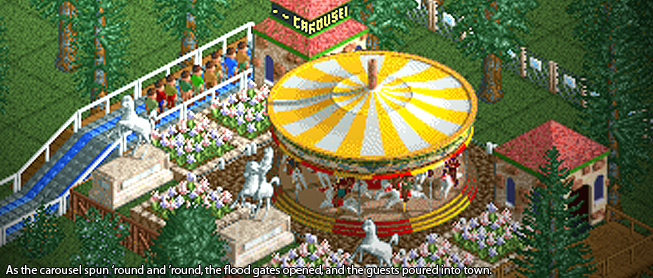
Pulling up the construction options again, I decided to install a
Merry-go-Round for a touch of class. Additionally, this provided a bit of
variety: Evergreen would cater to the men, while the carousel would be
the stereotypical "pansy ride." This way, everyone would have something to
do, instead of watching the pinecones fall to the ground.
With my mind made up, I surveyed the park's layout once more. As I mentioned
before, location is a universal priority, regardless of which type of ride
is being constructed. To keep matters simple, I chose to place the
Merry-go-Round on the left side of the main path, across from Evergreen.
While I could have casually plopped the ride down in the left corner, I took
some time (about a week in-game) to create a pansy-friendly ambiance.
I propped the carousel up on a small pedestal, and surrounded it with
flower gardens and statues. This created a miniature courtyard, which I
closed in with the queuing line and the exit path. With that, I set the admission price to $1.20, and opened
the Merry-go-Round. Several kids could not contain themselves and squealed in glee.
The two operational rides gave me the incentive to double the park's entrance
fee (from $6.00 to $12.00). Guests continued to flow through the gate at the head of
the park, which kept me motivated to improve the furnishing on my grounds.
After I caught a glance of several green-faced individuals, I quickly realized
that I needed to hire some employees to keep matters
running smoothly. With this in mind, I acquired one Handyman, one Mechanic, and
one Security Guard. These guys helped maintain order and hygiene throughout
the land, like a band of self-proclaimed superheroes.
Furthermore, I needed to install some hospitality shops for my guests. Without delay,
I constructed a Burger Bar, a Drinks Stall, an Ice Cream parlor, and a shit shack
to accommodate the bodily needs and functions of my patrons.
I still had one week left in the month, so in a bit of a rush, I erected a
Ferris Wheel adjacent to the carousel. I surrounded it with a row of pine
trees and a pair of fountains. I also lined the queuing line and exit path with
some handsome oriental bushes, you know, for a bit of pizazz.
Afterwards, I opened up the ride to the public and charged 'em a buck.
With a default color scheme of white and yellow, I decided to call it Sun Wheel.
The completion of Sun Wheel allowed me to jack up the park's entrance fee to
$15.00. I used to last few days of the month to relax, as I watched my wallet
grow plump.
By the end of April, there were 137 guests enjoying themselves within the
white, chain-linked fence. My park rating had skyrocketed from 0 to 790 in a
single month, which put a grin on my face. Yet as I took a good look at my
economic whereabouts, that grin began to fade. Although my park value was at
a healthy $4,375.40, my company value was in the red, at $-2,251.50. Fortunately,
the monthly trend depicted a steady climb out of debt, as my admission tickets
alone had already raked in a sizeable $1,537.00. Determined to break out of the
red, I got up off my rump and headed back out to the fields, jackhammer in hand.
| ||||||||||||||||||||||||||||
|
May, Year 1
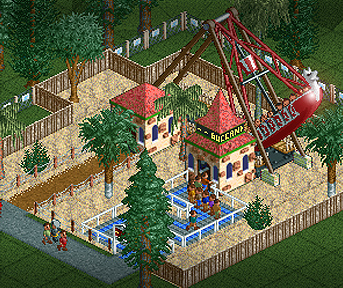
Searching for an interesting, cheap option, I opened up the "thrill ride"
section. Currently, there were two rides available - the "Scrambled Eggs"
I mentioned earlier, and the "Swinging Ship." Both could be constructed
for well under $1,000, but I went with the Swinging Ship for a fairly
significant reason. The "excitement" and "intensity" ratings of the Scrambled
Eggs were almost identical to those of the Merry-go-Round and the Ferris Wheel.
In Roller Coaster Tycoon, diversity in ride "ratings" will naturally encompass
a greater number of paying guests. So, the Swinging Ship would cater to
the individuals who were sick of the "gentle rides," but whom also didn't quite have
the testicles to hop on Evergreen.
Now with a set objective, I constructed a path that branched off the main
boulevard. It carried left, behind Sun Wheel into a snug corner of the park. This
is where I chose to build my Swinging Ship. I started by whipping out the
chainsaw and cutting through the thick trunks of any interfering pine trees.
With them out of the way, I placed the axel, ship, and supports into position,
and built the entrance and exit paths. The ride looked out of place in the
middle of a forest, so I spent an extra $100 or so sprucing up its surroundings.
A couple hundred pounds of sand and some imported tropical foliage was all
it took to truly complete my Swinging Ship. Being the salty sea dog that
it was, I went ahead and called the ride, "Buccaneer." I opened the ride
and set the admission ticket price to $1.50.
As I had predicted, guests began to flock toward the giant, crusty galleon.
Buccaneer began turning a profit almost immediately, and with that, my company's value began
a tremendous ascent out of the red.
By the time I had finished Buccaneer, it was May 19th. With under two weeks
remaining in the month, I saw this as an opportunity to improve my financial
position. I decided to halt all construction in order to gain an economic
foothold, and elevated the price of the park's entrance fee to $20.00.
With that, I headed back toward my office. Once in, I tucked
the chainsaw and jackhammer away in the corner of my office, took a seat in
a recliner, and ate some of those delectable Milano cookies.
May turned out to be a fantastic month for the business. My park rating had
increased to a solid score of 808. Guests continued to pile in, and currently,
there were 253 in the park. This meant that I had met my primary objective
(of achieving 250 guests in the park with a park rating of at least 600), and
I simply needed to maintain my neoteric stance. Additionally, my park's value
had grown considerably - to $6,247.00. However, what impressed me the most
was my company's value. At $965.50, it was well into the green already, and it
didn't show any signs of deteriorating. Evergreen was now raking in almost
$500 a month, and my entrance tickets had accumulated a small fortune of
$3,822.00.
The recent success really went well with those Milano cookies, and I walked back
to the park in high spirits.
| ||||||||||||||||||||||||||||
|
June, Year 1
Although I needed to bide my time in order to save up some cash, I couldn't let
myself go an entire month without building a single new attraction. Remaining
conservative, I opened up the "gentle ride" construction options and took
a look around. Carousel and Sun Wheel were already operational, so a
Merry-go-Round or Ferris Wheel was out of the question. Instead, I chose
to construct a simple Spiral Slide.
Now, a slide seems to barely constitute a fitting amusement park attraction,
but the munchkins really get a kick out of it. I knew it wouldn't produce
much of a direct profit, but an indirect profit was certainly possible.
In other words, I knew I was only going to charge pennies on the
dollar for the actual admission fee. However, the grand opening of a new ride
would attract 20, maybe 30 new guests to the park. With the current entrance
price of $20.00, a quick $400 to $600 could be made. Pizza money for a true
tycoon, but I needed all the cushion I could get.
Across the path from Buccaneer, I set up shop and constructed the Spiral
Slide. I enveloped it in a lush garden, complete with flowerbeds and hedge
walls to attract the pansies (no pun intended). Although the blossoms were
a spectacular sight, I needed to man things up a bit. With a hasty alteration
in the color scheme, I named the tower, "Super Slide," after the one and
only Superman. However, if you take a glance at the picture, you'll see that
my efforts to increase the ride's masculinity failed miserably. Regardless,
I opened up the slide and set the price to $0.80.
With the fore coming economic stability, I agreed to install another roller
coaster sometime in July. I ordered my scientists to research only coaster-related
technologies, and began to scope out a construction site. I settled on the
back left corner of the park - beyond Buccaneer and Super Slide. Within
the next few weeks, I was informed that the new Steel Roller Coaster model
would be available by the beginning of July. From what I recalled, it was
a far more versatile track than the Steel Mini or Wooden models, capable of
banked turns, helixes, launching station platforms, and loops. In essence,
it was the Corvette to Evergreen's Oldsmobile, and for the next few days, I
anxiously awaited July 1st.
June ended with a fair amount of success. My park rating had shimmied up
to 818 and I catered to a total of 301 guests. My company's value began to
show some real strength at $1,840.70, as did my park's value, which
was now at $7,118.40. For once, the numbers appeared to be on my side. With
plentiful cash and a hefty reserve in the banks, I commandeered the construction
of my new steel monster.
| ||||||||||||||||||||||||||||
|
July, Year 1
The construction of the new Steel Roller Coaster began without
delay. Just like any track, I began with the station platform, which I positioned
perpendicular to the main path. However, instead of creating the chain
lift hill at the front of the platform, I decided to make use of the
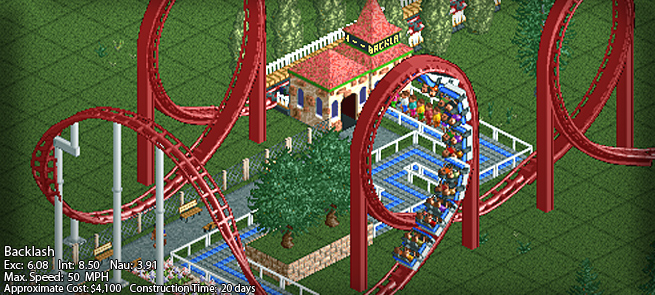
model's versatility, and constructed a reverse lift hill. This meant that
the train would be pulled backward up the chain, behind the station, and
would then be dropped once it reached the top. From there, I placed
a loop, followed by an arching U-turn. Next came two more loops
and the final slope. Once the train depleted its momentum, it would fall
back down the slope and go through the entire track a second time ... backward.
This "boomerang" design would not only invigorate and captivate my guests,
it would also save me 50% on construction costs. Here's what I mean: instead
of building a track twice as long, the train would simply travel through
the course two times, which, in a sense, allowed me to construct an exciting
ride for half the price.
As I completed the track, I was interested to see just how peachy matters
would be. For a mere $4,100, the steel serpent looked quite impressive, and without further
dilly-dallying, I hit the "test" button. The sleek train began its reverse
ascent into the air. It was a strange sight watching the two-ton vehicle
being towed so effortlessly into the sky. As it reached the top of the chain,
the train was released, and it plummeted back down to Earth in near free-fall.
To keep things short 'n sweet, the train completed the course without a hitch.
The roller coaster had attained a maximum speed of 50 miles per hour, which
would surely blow a few hats off. Eagerly, I checked out the rest of the
statistics. With an 8.50 intensity rating, this thing packed a punch. In
addition, it possessed a high excitement rating of 6.08, which would hopefully
produce many returning customers. What surprised me a bit at first was
the relatively low nausea rating of 3.91. Guests would be inverted a total
of six times at speeds at or near 50 MPH, and three of the inversions would
be performed in reverse. To me, a 3.91 seemed much too low. Eventually, however,
I took into account the sheer smoothness
of the steel track, which must have been responsible for such an astonishing
piece of data.
With the test results in, it was time to open up the ride. I greatly admired
the "boomerang" design that had worked so well for me, so I named the
roller coaster, "Backlash." Ever concerned with finances, I milked this baby
for all it was worth, and charged a hefty $3.00 admission fee. With that, I
unveiled my newest attraction to the public. Needless to say, it was received
quite well.
Upon opening Backlash, I took a glance at the calander. It was already
July 20th, so with a week and a half left in the month, I reverted back
to my conservative game plan. The new roller coaster allowed me to boost
the park's entrance fee to $25.00, and I temporarily ceased all construction.
For the time being, my job was done, so I headed back towards my trusty
office. Once in, I became disgruntled upon the discovery that my janitor
had eaten the last of my Milano cookies. That bitch was so fired.
Despite the four grand I used to erect Backlash, July was a very prosperous
month. The cutting edge steel attraction was already luring in the guests
(now totaling 373). It also appeared to have a positive effect on my park's
rating, which had been elevated to 837. Surprisingly, my company's value did not sink
back down into the red. In fact, it was at $2,114.10, almost $300 higher than
it was in June. As the cherry on top, my park's value had exceeded ten grand,
and it seemed as though my wealth would increase exponentially in the coming
months. My investment in the steel technology was perhaps the most
intelligent decision I had made yet.
| ||||||||||||||||||||||||||||
| ||||||||||||||||||||||||||||
|
August, Year 1
The influx of new guests required additional shops and stalls.
Already, I noticed a small lapse in my park rating, so I built
another Burger Bar, Drinks Stall, and Restroom to better accommodate my
visitors. These minor installations quelled the decline.
The growing crowd of guests also increased the demand for new employees.
To pacify the rambunctious mob, I hired two Entertainers. Little did I know,
they were accomplished tap dancers, and they began performing selections
from several 1950's musicals all throughout the park. I shrugged, and kept
a move on.
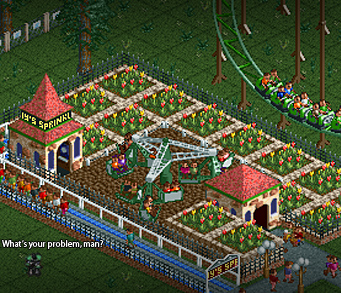
Digging back into the "thrill ride" section, I came across the Scrambled
Eggs again. With nothing better to do, and a construction cost under $500,
I decided make it my next project. As I examined the park's layout, I chose to
place the attraction next to Evergreen. The left side of the park was almost
completely full. Placing the Scrambled Eggs on the right side equalized the
park's overall arrangement. Once I had the ride set up, I began another
one of my slightly awkward decorating jobs. This time, it wasn't too elaborate.
As you can see from the picture, I pretty much just raped the thing with
tulips and called it a day.
Yet, somehow I knew my task wasn't quite finished. I once again had the
urge to man things up. With a new teal paint job, I named the ride, "Jimmy's
Sprinkler," after the noble James Raynor of Tarsonis. As I took another
look at the contraption, however, I realized that my efforts to give the
ride some testicles had been inconceivably laughable.
Putting my shortcomings aside, I opened up Jimmy's Sprinkler and set the
admission ticket price to $1.00. Apparently, the guests didn't let the name
deter them from the ride, and soon, a sizable line formed outside the entrance.
For the past few months, Forest Frontiers had continually shown improvement.
August presented no exception to this trend. The plethora of benefits that
Backlash had been providing finally showed up in the numbers. The most obvious
was the amount of guests in the park. So far, the steel coaster had brought in over 80
visitors, raising the grand total to 454. It had also put smiles on dozens
of faces, which boosted the park rating to an excellent 858. Financially,
matters were equally prosperous. My company's value had shot up tremendously
to $4,054.30, and the park's value was now estimated at $11,372.40.
From here, it seemed as if I was approaching the home stretch. My statistics
were well above what the primary objective demanded, which kept my nerves
on easy street. Imbued with confidence, I looked forward to September and
whatever it had to hurl at me.
| ||||||||||||||||||||||||||||
|
September, Year 1
With the house up, I constructed the entrance and exit paths. From there, I
opened up the ride and charged $0.70. I decided to play it safe after the
"Jimmy's Sprinkler" incident, so the attraction was named, simply, "Frontier Mansion."
The construction of Frontier Mansion was almost purely for beans and giggles.
It truly felt like a half-assed excuse for a building project. Even though
I was in the clear, I still had a month and a half until the park's final
inspection. Frankly, I was becoming a bit bored, so once again, I rummaged
through my construction options.
Eventually, I came upon the "water rides" section. Here, I found the schematics
for a Log Flume and a Water Slide. While both were great choices, I only
had time to build one. Under pressure, I hastily chose the
Water Slide.
Discounting the obvious time issue, I remained persistently
uneasy about the project. Even though I was currently in an excellent economic position,
I knew that ride construction could always pose a threat to my financial stability.
Slightly off balance, I began building the Water Slide.
To remedy the lopsided layout of my park to a greater extent, I chose to
site the Water Slide at the far right corner of the park - past Jimmy's
Sprinkler and Frontier Mansion. The corner was home to a considerable
amount of pine trees, and as a result, I paid a high lumberjack fee. Additionally,
I needed to purchase some land in order to harbor the slide's lengthy design.
All together, these expenses set me back around $2,000, which at the time,
did not bother me a great deal. My main concern was completing the Water
Slide on time.
With my newly acquired land, I was able to construct a tall lift hill.
Once I reached the park's limits, I U-turned the track toward
Backlash. Then, I plunged the ride downward into an underground tunnel.
I recalled the fact that I had already spent two grand on preparation, so as
I resurfaced, I made the decision to head back to the station platform
immediately. All said and done, it was a simple, elliptical track with one
monstrous drop.
Just as I wrapped up construction and hit the "test" button, the month ended.
It was now October 1st, and judgment day grew ever closer.
Financially, I had taken a big hit from the Water Slide construction. My
company's value had tumbled to an exiguous $1,966.30, less than half of
last month's value. To make matters worse, my park rating had fallen over
20 points to 834. It seemed as though I had gotten myself into a game of
Russian Roulette overnight, and the gun was already loaded.
| ||||||||||||||||||||||||||||
|
October, Year 1
The dinghies began their rise via the lift hill. One by one, they followed
each other in an eerie synchronization. The boats then completed the U-turn,
and plunged into the tunnel. The sound of splashing water echoed through
the tubes, and out of the darkness, came the first dinghy. Its arrival in
the station was absolutely elating.
With a functional track, I now awaited the test results. I took another glance
at my company's value. It had improved slightly, at $2,125.90, but certainly, there was
still a long road to recovery. With only three weeks left until judgment
day, a complete economic rebound seemed almost unfathomable. Regardless, I
kept my fingers crossed.
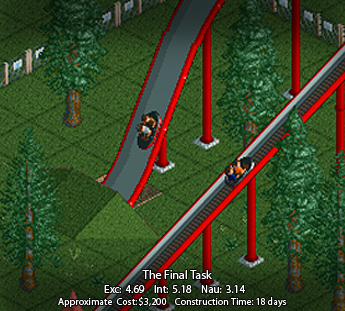
Within a few seconds, I again had something to smile about. The test results
had returned and were in perfect measure. The slide possessed an excitement
rating of 4.69, which topped that of Evergreen. It also boasted a 5.18
intensity rating, which would allow the ride to cater to a wide variety
of guests. As pleased as I was, I knew I had to keep up with the race
against time. Quickly, I constructed an entrance and exit, opened the
new ride, and charged $2.20 for admission. Seeing as how the Water Slide
was a "do or die" project (and certainly my last), I christened the
attraction, "The Final Task."
At long last, I could afford to take a deep breath. The Final Task was
fully operational, and guests were already packing into the queuing line.
Its unveiling allowed me to crank up the park's admission fee to $30.00,
which began to aid my financial status immediately. Word of the new Water
Slide seemed to spread like wildfire, and a large influx of guests were
soon entering the park. Within a minute, the queuing line was bursting at
its seams, and for the first time, I saw an ounce of brilliance in my
risky project.
In order to keep up with all the new customers, I strengthened my work force
in the field. I hired a total of seven new employees to serve the needs
and demands of both the people and the attractions. This action steadily increased
the park's rating, as my guests remained satisfied.
For the last week of October, I did not give a single command. All pieces
were in their place, and it was far too late to jumble them around.
By now, I was chewing my fingers off in awful anticipation. While the raw
numbers remained on my side, I dearly hoped that I had fully recovered from
the recent ride construction. For the time being, I wanted the naming of
"Jimmy's Sprinkler" to be the only blunder in my gameplay. From there, I sat, and waited.
October came to an end, and as it did, the entire park erupted into cheer.
With 577 people through the gate and a healthy park rating of 887, I had achieved
my primary objective with flying colors. The mayor of the town came by
and handed me a glorious trophy, and a little kid gave me one of the Milano
cookies he was about to enjoy. I felt like a prince as the balloons and
confetti rained down on my loyal patrons.
Suddenly, a government sedan pulled up outside the entrance gate. An agent
exited the vehicle, earpiece and all. With a stolid face, he handed me the
year's financial report. I peered at my reflection in his Smith shades, and
uneasily opened the envelope. To my utter disbelief, the report did not
contain a single red number. In fact, I had made a full economic recovery
and then some.
I finished the game with a company value of $6,678.70 and a park value of
$13,668.40. I was nearly dumfounded. My company's value had almost
quadrupled in a single month, and was over two and a half grand stronger
than its previous peak in August. My park's entrance tickets had raked in
a total of $12,567.00, which alone, almost covered the expense of every ride's construction
cost.
With a sly grin, I returned to my office. My jackhammer and chainsaw rested
peacefully in the corner, and with a brand new box of Milano cookies on my
desk, my jubilation seemed practically infinite.
In the end, I had beaten the Man at his own game, while nearly shooting
myself in the foot. Cheers.
| ||||||||||||||||||||||||||||

| ||||||||||||||||||||||||||||
| View or Add Comments (# of comments thus far: 11) Back to Report Listing | ||||||||||||||||||||||||||||


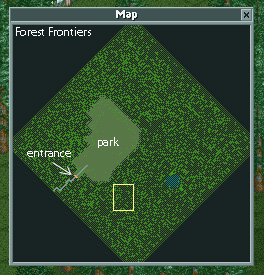 Alright, here we are. I have been shipped off to a picturesque forest with
no visible signs of life. There was a white, chain-linked fence that
closed off my park from the rest of the world. As you can see from the
map overview, the layout was fairly simple, with only a few trees standing
in the clearing. There was a single, concrete path that snaked its way
out through the park entrance, and eventually trailed off the map
entirely (this path represents the spawn point for my guests, who will
show up as soon as I construct my first ride or attraction). I found
the objectives list at the top of the screen.
My goal was to simply accumulate 250 guests by the end of October, Year 1, with
a park rating of at least 600.
Alright, here we are. I have been shipped off to a picturesque forest with
no visible signs of life. There was a white, chain-linked fence that
closed off my park from the rest of the world. As you can see from the
map overview, the layout was fairly simple, with only a few trees standing
in the clearing. There was a single, concrete path that snaked its way
out through the park entrance, and eventually trailed off the map
entirely (this path represents the spawn point for my guests, who will
show up as soon as I construct my first ride or attraction). I found
the objectives list at the top of the screen.
My goal was to simply accumulate 250 guests by the end of October, Year 1, with
a park rating of at least 600.
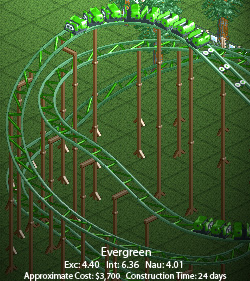 I began with the "station platform," the start and finish point of any
coaster circuit, and the location where guests can board or vacate the ride.
Then, I U-turned the track away from the entrance and began the ascent toward
the mighty blue sky. Once I had built up a considerable amount of potential
energy, I plunged the track downward in a curved slope. From there, I guided
the steel frame through a series of hills and curves, creating a layout that
looked similar to a multi-layered racing track, or a stadium if you will.
I began with the "station platform," the start and finish point of any
coaster circuit, and the location where guests can board or vacate the ride.
Then, I U-turned the track away from the entrance and began the ascent toward
the mighty blue sky. Once I had built up a considerable amount of potential
energy, I plunged the track downward in a curved slope. From there, I guided
the steel frame through a series of hills and curves, creating a layout that
looked similar to a multi-layered racing track, or a stadium if you will.
 Resolute, I cut any frivolous expenditure. I went into another deep
brainstorm to review my economic options. One thing was for sure - I couldn't
afford to construct another roller coaster yet. That would put me neck-deep
in red numbers, and while recovery and prosperity would certainly occur, the green
may not occur in time (by October, Year 1). In fact, I felt uneasy spending
more than one grand at the moment.
Resolute, I cut any frivolous expenditure. I went into another deep
brainstorm to review my economic options. One thing was for sure - I couldn't
afford to construct another roller coaster yet. That would put me neck-deep
in red numbers, and while recovery and prosperity would certainly occur, the green
may not occur in time (by October, Year 1). In fact, I felt uneasy spending
more than one grand at the moment.
 Still wary of my mediocre financial position, I decided to
halt the majority of construction throughout June. My company's value continued
its steady climb, as did my park's value.
Still wary of my mediocre financial position, I decided to
halt the majority of construction throughout June. My company's value continued
its steady climb, as did my park's value.
 Constructing Backlash took a lot out of me, so I opted to use
August for some general park maintenance.
Constructing Backlash took a lot out of me, so I opted to use
August for some general park maintenance.
 Back in the field, I quickly decided to build a Haunted House,
as it would probably be a hassle-free installation. As I plopped the mansion into place
next to Jimmy's Sprinkler, I began to wonder where these things were
manufactured. More importantly, what kind of person spends their life
assembling rickety old haunted buildings? Do a bunch of would-be architects
get together in a warehouse, drink a whole bunch of whiskey, and crank up
the miter saws? Seemed like a whole bunch of balderdash to me, but I wasn't about
to waste any more time on the subject. Shit-faced architects will be
shit-faced architects, I suppose.
Back in the field, I quickly decided to build a Haunted House,
as it would probably be a hassle-free installation. As I plopped the mansion into place
next to Jimmy's Sprinkler, I began to wonder where these things were
manufactured. More importantly, what kind of person spends their life
assembling rickety old haunted buildings? Do a bunch of would-be architects
get together in a warehouse, drink a whole bunch of whiskey, and crank up
the miter saws? Seemed like a whole bunch of balderdash to me, but I wasn't about
to waste any more time on the subject. Shit-faced architects will be
shit-faced architects, I suppose.
 Crunch time.