Turning Weakness into Strength
Hajdari vs. Rumpelstiltskin
Well hello there... fancy seeing you in a place like this. Shhh,
keep your voice down; people are still playing. Just pull up a chair - gently
- and I'll set up the pieces for you. I'm going to show you a game that's
a couple of years old, but somehow it has stuck with me. Nothing special
about it, really; just a nice illustration of a few sound principles in
games, character - hell, in life. That's what's so great about universal
truths. They are universal.
I've played quite a few chess tournaments over the last ten years. Some
of them I remember fondly (winning MSF Open in '98 at 7 points out of 7,
scoring 5.5 out of 6 in '96 while suffering a quadruple sinus infection
and high fever for instance) whereas most are too embarassing to mention.
The game I'm going to show you today is from one of those embarassing ones.
Suffice to say - nothing. My overall performance warrants no comment. Hopefully,
this game will. Probably my one redeeming feature throughout the season.
Map: The 64 Squares
Normal Resources
Hajdari randoms as White (bottom)
I random as Black (top)
As you'll see in this game, I used to have problems with this starting location.
I was trying to adapt my natural playing style (aggressive, tactical, overt)
to the slight disadvantage of having the second move instead of the first.
This didn't work out very well at all, and led me to experiment with structural
openings instead of dynamic ones - only to discover that still waters run
deep; even the closed pawn chains of the French Advance Variation offer
plenty for the imagination. Anywho, White, as always, begins. (Chess is
such a racist game, honestly.)

1. e4
Staking a claim in the center, and hoping for an open game. We can surmise
that Mr Hajdari is an active, tactical and aggressive White player.

1. ... e6
Tonnotes the French Defense, named after a famous correspondence match between
England and France in the late 19th century. Bit of a wolf in sheeps clothing,
the French. It can be played as solidly as you want - and as double-edged.

2. Nc3
White usually plays 2. d4 here, but clearly my opponent is not inclined
to follow mainstream theory. After all, he is White - he's in the drivers'
seat.

2. ... d5
Setting up the traditional French Defense pawn structure: pawns on the light
squares f7, e6 and d5. Takes control of the central light squares and sets
up a platform for middle-game maneuvres.

3. exd5
Tearing down the traditional French Defense pawn structure. My amassed opening
preparation of the French Defense is now void, as it has little (read: no)
bearing on the positions that will arise. Damn.

3. ... exd5
If you've ever gotten a piece of chess advice (apart from things like "Take
his King!") then chances are it was "Don't bring your Queen out
too early." The reason is simple enough: during the opening stage of
a chess game, developing your pieces (preferably around the center) and
claiming space is crucial. Falling behind in development is like letting
someone double-expand in Starcraft while you're tending to your Main. Not
to mention that in this particular case, Queen takes pawn is met by Knight
takes Queen. What I'm trying to say is: feel free to be creative at the
board, but it's rarely a good time to break all the rules of the opening.

4. d4
Claiming more space and opening lines for his pieces.

4. ... g6?!
Breaking all the rules of the opening. Traditionally, this Bishop should
remain on its diagonal in the French Opening to support the pawn push ...c5,
challenging the White center. Allowing your opponent a strong center is,
well, ill advised. I was thinking I'd stick it on g7, where it can potentially
control the long diagonal and possibly even provide some extra shelter for
my King when I've castled.

5. Nf3
Sound development: non-committal, eyeing the center.
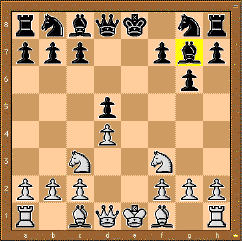
5. ... Bg7
Any other deployment of this Bishop would render my previous move a waste
of time. Not to mention my King would castle right into a swiss cheese of
dark-square weaknesses.

6. g3
Copycat. Still, I was slightly relieved. In following suit, my opponent
informs me he's not going for an all-out King hunt. Like me, he's honing
his pieces onto the Queen-side. This means the game will not really revolve
around tactical attacks, but rather a strategic battle for Queen-side dominance.
Whoever crashes through and forces a concession on the left side of the
board, will probably get to pick up material (a free pawn, a Rook for a
minor piece) that will aid him in winning a drawn-out battle. Chess games
rarely end with mate these days - but rather resignation in the face of
unavoidable loss, however far into the future.
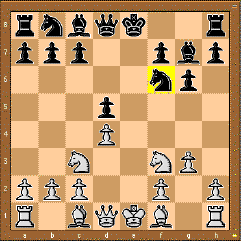
6. ... Nf6
Completing my King-side development and preparing to castle into safety.
Leaving your King in the center is like not guarding your choke - you're
just asking for it.

7. Bg2
Saw that coming, didn't you?
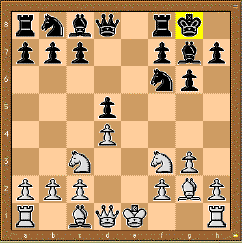
7. ... O-O
And that too, right? You're getting the hang of it.

8. O-O
And the opening is over. We're about to transpose into the middle game,
from what is a fairly even position, all things considered. It is said that
White's objective in the opening is to secure a favourable position, owing
to his extra move, while Black must struggle to equalize. Here, I'd like
to think Black has equalized. I mean hey - I even castled before
he did. Which instills me with a false sense of security. Which makes me
feel like I'm controlling the game. Which makes me feel like attacking something.
Anything.

8. ... Bg4
Not necessarily a bad move, but not really a good one either. In most French
Openings, this Bishop is something of a problem piece - with pawns on the
light squares f7, e6 and d5 it is easy to see that this Bishop doesn't enjoy
a great deal of mobility. This is why Black players often try to exchange
it off for a White Knight or - even better - the enemy Bishop. But since
Hajdari exchanged off those center pawns, the board is quite open. There
is no need for me to part with this piece. I just felt active. This is as
likely to do any serious damage as taking five minutes to 4-pool.

9. Bg5
But when he does it, it actually works. Because I let it. I compromise my
pawn structure to shoo away the attacking piece. I should have just suffered
it; the threat is stronger than the execution. (Unless, of course, you are
the one being executed.)

9. ... h6
Putting the question to the Bishop.

10. Bxf6
Exchanging gladly, now that he's forced a concession.

10. ... Bxf6
Recapturing. Maintains the material equilibrium. (I know, I know; if you
need it spelled out for you then you've probably not read this far, but
hey - wouldn't it freak you out if I started skipping diagrams?)

11. Qd2
Completing the second part of his development, connecting the Rooks on the
first rank, centralizing the Queen and - almost incidentally - hitting the
unguarded pawn on h6.
Now, the correct way for Black to play here is to simply retract the Bishop
to g7. This way, the structural weakness on h6 is minimized, the f-pawn
is unblocked and can advance - all pretty obvious stuff. There's just one
problem: I hate retracting pieces. It makes me feel stupid. Like "chucks,
that piece didn't belong there in the first place, I'm-a gonna take it back".
Silly, childish, immature. That's the kind of guy I am, apparently.

11. ... Kg7
I'd like to say I've learned form my mistakes and that I wouldn't play like
this today. I really would. I just don't happen to think it's true.

12. Ne2
Remember I was talking before about how the real battle was going to be
on the Queenside? Well, that's pretty much out the window. Right about now,
it's become quite clear to my opponent that he's playing against someone
who is, well, not necessarily the successor to Boris Spasskij. This is why
he starts bringing his pieces over to the Kingside instead. It's his way
of saying he doesn't have to worry about niceties like pawn structures and
central pressure anymore - he's going to try and crash through in the center
and eat my King. After this move, the Knight is closer to the action, and
the c-pawn is free to storm up the board.

12. ... Bxf3
Now or never. One of the great chess truths are that an endgame with opposite
coloured Bishops is easier to defend and draw for the weaker side, than
any other piece combination. And judging by the leers and sneers I got when
people walked by my board, going for a draw seemed pretty damn optimistic
right about now. I know, I know; there's still material equality and there's
not even a hint of the fat lady; but the big picture is pretty clear and
if my name is in the credits at all, it's as Schmuck #1.

13. Bxf3
(See note to Blacks' 10th move.)

13. ... Bg5
Well, the Bishop finally leaves f6 (and with tempo - yeay), but it'd sure
be a helluva lot better placed on g7. As there is now a White Bishop on
f3, at least he can't shoo it away immediately with pushing the f-pawn to
f4, but there's no need to unpack: g5 should never be allowed a permanent
home for my Bishop.

14. Qd3
Moving the Queen out of harms way.

14. ... Nc6
I finally develop my last minor piece. Pity I chose such a rotten square
for it. I should use the square c6 for a pawn (propping up the center),
and play the Knight to d7. If the Bishop on g5 (stupid animal) was on g7
instead, the square f6 could be a good future home for the Knight. Could
have, would have, should have...

15. c3
There is an old chess truism: He who is better developed has not only the
right but the obligation to carry out an attack. Playing c3 isn't mounting
an attack. It is like looking at your resources in Starcraft, "oooh,
I have 8000 minerals, I must be winning..." It's not what you make,
Hajdari - it's how you spend it. This gives me time to re-group.
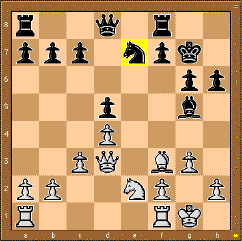
15. ... Ne7
He's not the only one who can post forces where they eye both the center
and the Kingside.

16. c4
Better late than never, I suppose. This is still a strong move, but no longer
terribly so.

16. ... c6
This shores up the center for now. Note that it would have been impossible
if White had played the pawn up to c4 straight away, as there was a Knight
occupying c6.

17. Rad1
And White is fully developed for crashing through. It is at this juncture
I take a deep breath, and force myself to analyze my somewhat constipated
position. I keep thinking about Znosko-Borovsky's maxim (well, one
of them, anyway): It is not a move, not even the best move, that you
should seek; but a realisable plan.
OK, so my position sucks. My pieces lack coordination, whereas their White
counterparts are harmoniously placed. What's the root of all evil, then?
What is my Achilles' heel? Why, that idiotic King on g7, of course. It has
no business there at all. Never had. It's as dumb as building Supply Depots
in front of your mineral line. But I can't move it. Because I hate retracting
pieces. Instead, I knuckle down and try to find a positive aspect of the
King standing on g7. I find none. I try again, but keep finding none. My
mind wanders and I start thinking of where I'm going to have lunch, and
whether or not I'm hungry enough to actually resign this game. (This is
just a Jedi mind trick of mine; considering resignation always wets my appetite
for destruction.) So I take another look at the board, and this time I'm
not even trying to look for good things stemming from the King on g7, but
any frigging thing at all. What does it mean, having a King on g7 instead
of g8? Hmm... eh... I guess it means that... well, that g8 is... empty.
So I could put another piece there. Maybe re-routing the Knight by it; let's
see: Knight goes from e7 to g8 to... h6 is blocked by a pawn, f6 perhaps...
no, then my Bishop is hemmed in. OK, so that's out then. What about a Rook?
On g8? Nonsense. It would even do more good on... wait... on h8. Yes. Yes,
that's it. With the King on g7, the power pieces on the eighth rank all
have swift access to the h-file. And all at once, I start seeing the patterns.
The sacrifices. The win.
Repeated diagram
This is the plan: first push the h-pawn and exchange it for his g-pawn.
This opens my half of the h-file, leading down to his pawn on h2. Sacrifice
either the Bishop or the Knight to divide up his forces (breaking their
communication) and clearing the way for my Queen on d8 to come into play
on f6, g5 or h4. Play the f8-Rook to h8, sacrifice it for the pawn on h2.
When the King captures, the other Rook goes from a8 to h8 with check, and
the White King gets caught in a mate net from the battering rams of the
Black Rook, Queen and minor piece. Ta-da!
All of this, of course, is only a plan. And, to paraphrase Clint Eastwood:
"Plans are like assholes. Everybody's got one, and some stink."
Be that as it may, even a bad plan is better than none at all.

17. ... h5
Setting the plan in motion.

18. g4
Wonderful. White estimates his own position to be so superior, that he gladly
invites the opening of lines. He believes this will speed my downfall. After
all, I'm just some schmuck ho stuck his King on g7, aren't I?

18. ... hxg4
Opening the top part of the h-file.

19. Bxg4
But now here comes the tricky bit: it is apparent from my opponents play
that he hasn't caught on to the boons of my King placement. If I were to
play my Rook to h8 on this or any of the coming several moves, he'd wise
up, shore up defenses and no doubt win the game. (After all, advancing pawns
like ...h5 and things like that are very committal. Kind of like rallying
your ground troops and storming in. If it works, you're a hero. If it fails,
you're a schmuck. History is written by the winners.) This is why I must
delay that all-important move Rook to h8 until it is so powerful that it
wins the game by force. Let's see, what else did I need to do in preparation
for the final onslaught... oh yes, freeing up the diagonal for my Queen
to jump into the game. So the Knight and the Bishop has to go. And now that
the White Bishop is no longer on f3, the d5 square looks absolutely great
as a home for the Knight, doesn't it?

19. ... dxc4
Vacating the square.

20. Qxc4
Recapturing the pawn.

20. ... Nd5
Centralizing the Knight with a vengeance. Note that the dark squares on
e3 and f4 are now firmly under Blacks control, as the Bishop and Knight
join forces. Black goes into a deep think, and plays...

What? What did he play? I see that my clock is ticking, but I can't for
the life of me see how the board is any different from when I got up to
stretch my legs. I have to lean over the table and consult his score sheet
to see what he has played. Can you see it? I deliberately refrained from
high-lighting it to see if you could find it. Give up? It was pawn from
a2 to a3.
Absolutely nonsensical. The only reasons I can imagine are his reluctance
to allow my Knight onto b4 after he moves his Queen away (as if I was going
that way...) and an inclination to undermine my Queenside pawnstructure
by pushing his pawns to provoke weaknesses. Incidentally, this is a strategically
sound plan. The only problem is that he doesn't have time for it. He's about
to get tactically crushed on the other side of the board.

21. ... f5
Pushing the Bishop away from the g-file. When the Queen does come out to
g5, it has to be check.

22. Bf3
To the untrained eye, It's still pretty much level. The active Knight on
d5 is about to be exchanged, and Whites structural weakness (no g-pawn which
means the h-pawn is permanently hard to defend) isn't necessarily worse
than Blacks (a backward pawn on g6 that might never be allowed to progress).
But the Dynamics are no longer working for White.

22. ... Bf4
Threatening to win immediately by sacrificing the Bishop on h2, drawing
the King into the line of fire.

23. Nxf4
Virtually forced.

23. ... Nxf4
The Knight is no less strong on this square.

24. d5
Following another great chess truism: the best way to refute a wing attack,
is to crash through in the center. But you can only refute an attack that
is unjustified. This one no longer is.

24. ... Qg5+
As I said: the Queen must come to g5 with check.

25. Kh1
Since the Knight is covering g2 - had he played the Bishop there, then Qxg2
is mate.

25. ... Rh8
The door slams shut. Now White has no time to push the Queen away, since
on Rook to g1 there follows Rook takes pawn on h2 (check), King takes Rook,
Rook to h8 and White can survive only one more move by giving up his Bishop
on h5.

26. Qc3+
Whites only way to avoid immediate mate is to give up material.
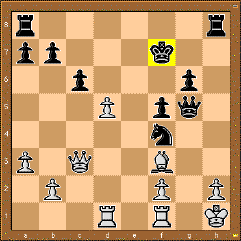
26. ... Kf7
Stepping out of check.

27. Qxh8
A Queen for a Rook means Black has won the exchange - not necessarily enough
in itself, but after...

27. ... Rxh8
...it is clear to see that the attack is far from over.

28. dxc6
Clearing an avenue for counter-attacking the Black King across the open
board.

28. ... Qh4
Renewing the mate threat. Spite checks give nothing, as Black simple brings
his King closer to where the real action is - in fact, the only way to postpone
mate is to keep checking until Black plays King captures Whites Bishop on
f3, creating yet another mate threat. I could walk you through it, but I
don't think it would do any good. Kind of like having 38 screenshots of
a gazillion Archons razing every last structure in an empty Main. Black
resigned on move 33, being down in material and facing a forced mate in
four moves.
There. I think we're about done. Goodness, is that the time? We'd better
lock up the place and call it a night. We can put the pieces back up next
time. Careful with the door; it sticks to the frame. You gotta- there you
go. Alright, take care now. Don't forget to practice. See you next time.
Lessons learned.
* Every cloud has a silver lining. I know it's pushing the envelope to kall
Kg7 the winning move, but hey - this couldn't have happened without it.
* It's never too late to give up. Which is as good a reason as any to keep
on fighting. And this applies equally to chess, Starcraft, life - and all
of the above.
* Spare a comment for an ex-leper?
|
 Home
Forum
Starcraft Tournaments
Home
Forum
Starcraft Tournaments


